 Polkaswap
 liquidity aggregation: Routing limits
Polkaswap’s on-chain routing compares available liquidity sources on SORA for a chosen token pair and amount. SMART selects the best-priced available source, while TBC uses the XOR token bonding curve directly. Execution remains limited by available pool assets, or by the curve’s reserves when selling XOR through TBC.
Updated on
SMART and TBC quote differences
SMART is the default market setting. The Liquidity Proxy selects the source with the best quoted price among the available options. Selecting TBC directs XOR purchases or sales to the curve: purchases deposit reserve assets and mint XOR, while sales burn XOR and release reserve assets.
Compare quotes with the same token direction and amount. SMART’s price calculation excludes PSWAP rewards. Any applicable reward for buying newly minted XOR is subject to vesting and cannot be claimed immediately. TBC prices can differ from XYK pool prices. Reserve backing affects the curve’s selling terms, and its pricing mechanism does not guarantee XOR price stability.
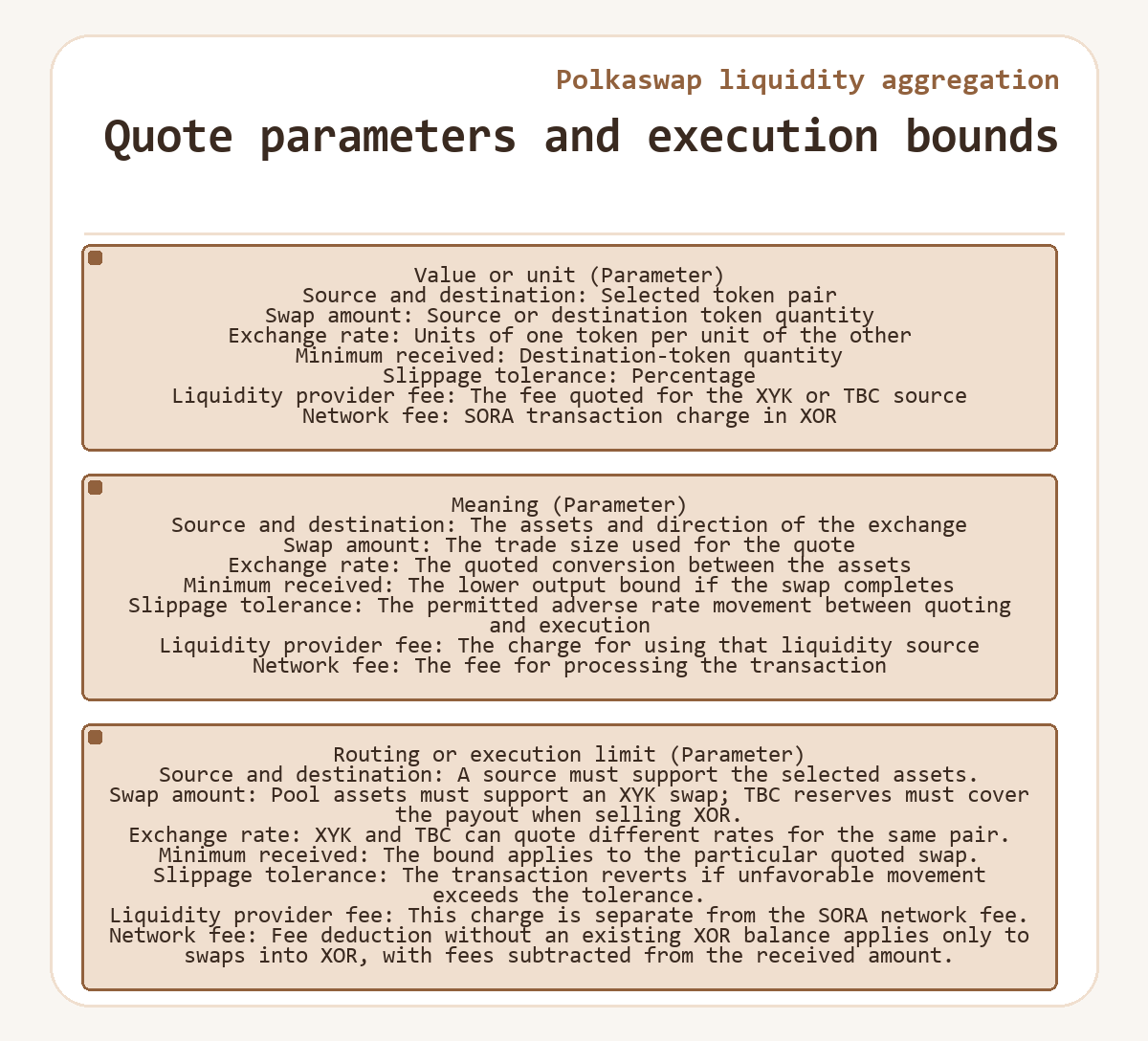
Quote parameters and execution bounds
| Parameter | Value or unit | Meaning | Routing or execution limit |
|---|---|---|---|
| Source and destination | Selected token pair | The assets and direction of the exchange | A source must support the selected assets. |
| Swap amount | Source or destination token quantity | The trade size used for the quote | Pool assets must support an XYK swap; TBC reserves must cover the payout when selling XOR. |
| Exchange rate | Units of one token per unit of the other | The quoted conversion between the assets | XYK and TBC can quote different rates for the same pair. |
| Minimum received | Destination-token quantity | The lower output bound if the swap completes | The bound applies to the particular quoted swap. |
| Slippage tolerance | Percentage | The permitted adverse rate movement between quoting and execution | The transaction reverts if unfavorable movement exceeds the tolerance. |
| Liquidity provider fee | The fee quoted for the XYK or TBC source | The charge for using that liquidity source | This charge is separate from the SORA network fee. |
| Network fee | SORA transaction charge in XOR | The fee for processing the transaction | Fee deduction without an existing XOR balance applies only to swaps into XOR, with fees subtracted from the received amount. |
Pool paths and insufficient liquidity
XYK pools use XOR as their base asset. A swap between non-XOR tokens can therefore depend on an XOR-paired pool on each side of the route. Each pool leg needs enough assets to support the requested exchange.
An insufficient-liquidity error can come from an XYK pool with too few assets or inadequate TBC reserves when selling XOR. For the XYK case, reducing the swap amount or waiting for additional pool liquidity can change whether the trade is possible. Slippage tolerance governs adverse price movement; increasing it does not add assets to either source.
Order-book prices and cross-chain assets
Polkaswap’s Trade chart reflects order-book trading data and excludes swap liquidity. A chart price alone therefore does not establish the amount that a SMART or TBC swap will return.
Cross-chain asset access depends on supported tokens and available bridge routes. Swaps settle on SORA using available liquidity. A connection to another chain does not establish that every asset on that chain has a usable swap route.